
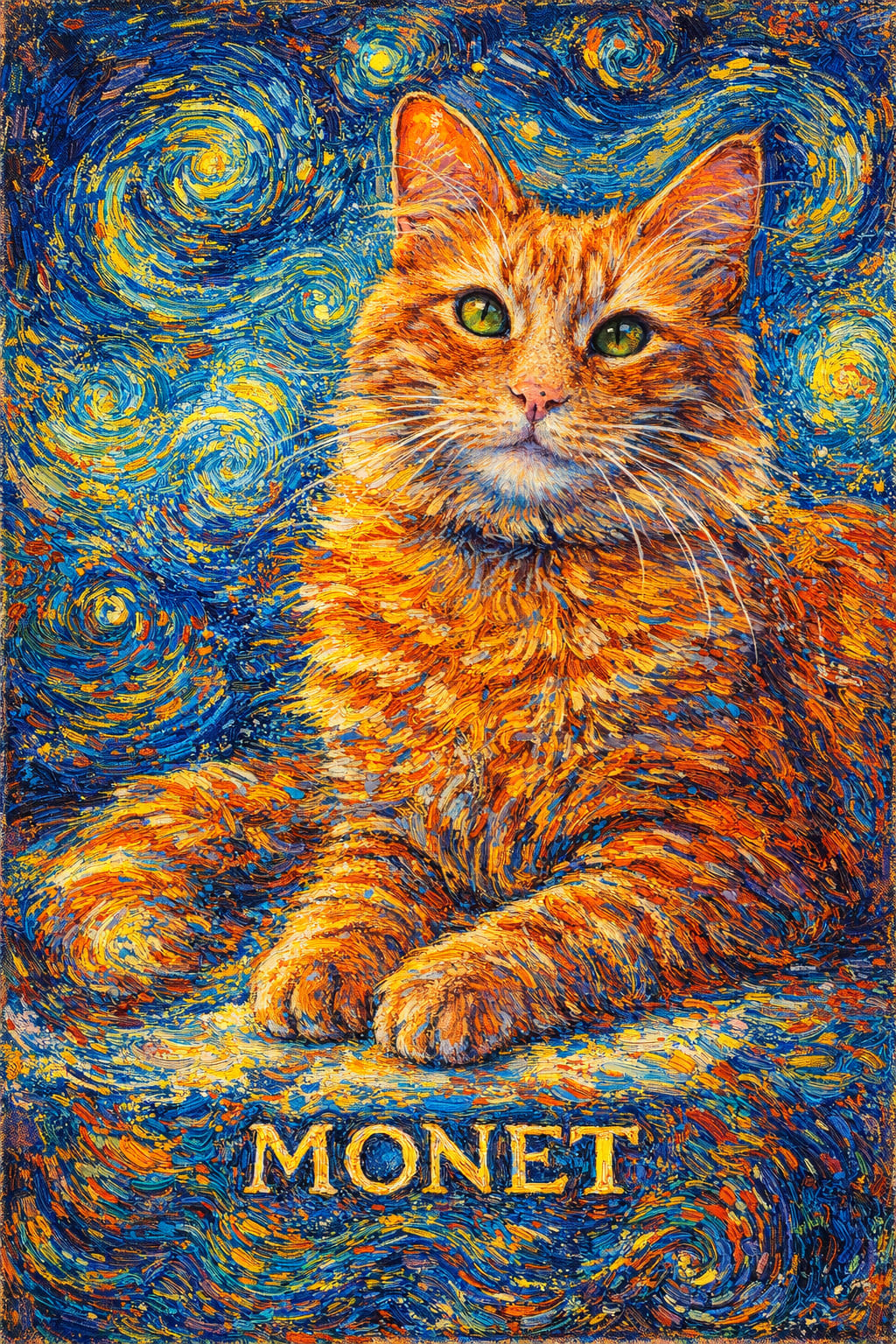
You have a frame. Maybe it held a print that no longer speaks to you, or it came from a flea market with a story attached. You want to put a portrait of your pet in it. Before you order, there are three measurements to understand, and none of them are the same thing.
Three measurements, three different jobs
The outside frame dimension is the footprint on the wall. It is the full width and height of the frame itself, corner to corner. That number tells you where it hangs and whether it fits between the bookshelf and the door. It does not tell you what size picture goes inside.
The opening is the window you see through. If the frame has a mat, the opening is the hole cut in the mat, not the frame. If there is no mat, the opening is the inside edge of the frame where the glass sits. This is the visible area your pet's face will live in.
The third measurement is the size the frame accepts. That is the space behind the opening, inside the rabbet, the little ledge that holds the glass, mat, and artwork. A frame can have a generous outside dimension and still accept only a modest print because the molding is wide and the rabbet is shallow. Knowing all three keeps you from ordering a print that swims or gets trimmed.
Record the real numbers, not the ones you remember
Take the frame off the wall and lay it face down on a table. Use a metal tape or a rigid ruler. Write down the outside width and height. Then measure the opening in both directions, and if there is a mat, measure the mat window separately from the frame's inner edge. Finally, measure the rabbet depth and the width of the ledge. A framer will ask for these, and guessing leads to returns.
While you are at it, note whether the frame has glass, what kind, and whether the backing is rigid. Those details affect how a print sits. If you are unsure, take a photo of the back with your phone and bring it to the shop. A framer can read a frame faster than any worksheet.
Ask about fit, overlap, and mounting
Fit is not just whether the print slides in. It is whether the print is held flat and square. Ask your framer whether the size you are considering leaves enough overlap for the mat to cover the edges of the print. Mat overlap is the margin by which the mat covers the artwork, and it varies by frame and mat. Do not assume a standard number. Ask.
Mounting matters too. A print can be hinged, cornered, or floated, and some methods suit a paper print while others suit a rigid panel. If you are considering a fine art paper print, ask how it should be mounted so it stays flat without pressing the surface. If you are thinking about a canvas print, ask whether the frame can accept the depth of the stretcher bars. Not every frame can be adapted, and a framer will tell you honestly.
This is also the moment to confirm the visible area. A portrait composed for a square opening may lose ears or a collar if the opening is a narrow rectangle. Our size guide covers how a portrait sits in a room, but fit in an existing frame is a separate conversation with your framer.
Three paths: keep the mat, cut a new one, or change the frame
Keeping the current mat is the simplest path if the opening suits the portrait and the mat is clean. A new mat can change the opening without changing the frame, and a framer can cut one to the proportions your portrait needs. A different frame is the third option when the rabbet is too shallow or the style fights the piece. None of these is automatically right. Each depends on the measurements you wrote down.
If you are ordering a framed print from us, start with the size that suits the portrait and then compare it to your frame's opening and rabbet. If you are ordering a digital file to print locally, keep the file preparation questions for your print shop and the fit questions for your framer. They are different jobs.
A simple worksheet to bring to the framer
- Outside frame width and height
- Opening width and height (mat window or frame inner edge)
- Rabbet depth and ledge width
- Glass present? Type if known
- Backing material and condition
- Portrait size you are considering
- Questions: overlap, mounting method, whether the frame can accept the print depth
Bring that sheet and a photo of the back. A framer can then tell you what fits, what needs a new mat, and what is better served by a different frame. You will leave knowing more than when you walked in, and your pet's portrait will sit in the frame it was meant for.