
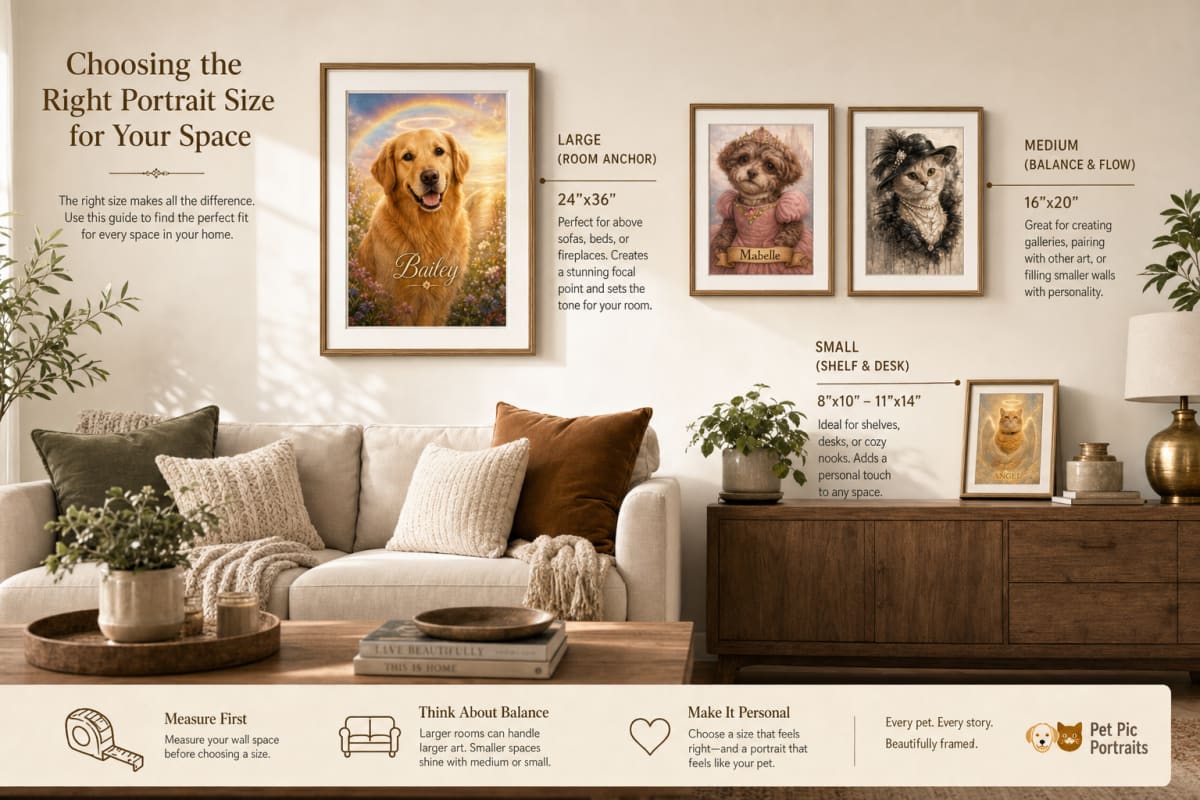
Choosing the size of a pet portrait feels like a small decision until you're staring at a blank wall with a tape measure in your hand. I've been there. When I made the first portrait of my own dog, I ordered a size that looked right on screen, and when it arrived it seemed lost on the wall. So let's talk about sizes that actually work, room by room, with the inch ranges I point our own families toward.
Once you have a spot in mind, every option is laid out on our pet portrait sizes page.
Start with the wall, not the portrait
The right size depends on where the portrait will hang or stand, and on how far away you'll be when you look at it. A desk piece can be small and intimate. A main wall piece has to hold its own from across the room. Viewing distance is the real guide.
Before you compare sizes, stand in the room and look at the empty space. A portrait that feels big on your screen can disappear on a wide wall, and a large piece can crowd a narrow one. Two quick habits help:
- Cut a piece of paper or cardboard to a candidate size and tape it up for a day
- Photograph the wall and squint at it. Empty zones jump out immediately
A good rule of thumb for a wall piece is to fill about two-thirds of the space you have. That leaves breathing room so it doesn't feel cramped. Hanging height matters as much as size. Centering the art near eye level, roughly 57 to 60 inches from the floor, is the standard galleries use. And if you're torn between two sizes, go a little bigger than you think. A portrait that fills its space feels intentional, like it belongs.
Desks, shelves, and nightstands: 8x10 and under
Small portraits are made for surfaces rather than walls. A 5x7 or 8x10 sits comfortably on a work desk, a bookshelf, a nightstand, or an entryway table. You're close to it, so the details matter. You can see the glint in your pet's eye and the texture of their fur. It feels personal, like a secret just for you.
This is the size I suggest when:
- You want your pet at your desk while you work
- The portrait is a gift and you don't know the recipient's wall space
- You're starting a collection and may add more pets later
At this scale, a frame earns its keep. A framed pet portrait stands on its own with no hanging hardware, which is why small framed pieces make such easy gifts.
Home office: inspiration at eye level
Your workspace deserves a touch of warmth. A small to medium piece, 5x7 or 8x10 on the desk or a nearby shelf, fits neatly without cluttering, and you can glance at it during calls as a reminder of who's waiting at home. For an office wall, 11x14 or 16x20 works well above a monitor or on a side wall. A portrait for your office in a classic oil painting look has a timeless feel that fits most decor.
If you're short on space, a digital download lets you print in any size that fits your nook, from a small desk frame to a larger wall piece.
Bedrooms, hallways, and above furniture: 11x14 to 16x20
This is the comfortable middle, and honestly where many homes land. An 11x14 or 16x20 holds its own on a bedroom wall, above a dresser, along a hallway, or over a reading chair.
Your bedroom is a place for quiet moments, so a portrait here can be softer. A watercolor style feels dreamy and gentle in a restful space, while a sketch feels more artistic and raw. Above a bed, think about proportions: a wide horizontal piece complements a headboard, and a square or vertical piece adds height.
A useful rule for hanging above furniture: aim for art around two-thirds the width of the piece below it. Above a 5-foot dresser, a 16x20 with a mat and frame lands right in that zone. Leave 6 to 10 inches between the furniture top and the bottom of the art. Closer feels crowded, and higher starts to look like the portrait is floating away.
In a hallway, mind the viewing distance. A narrow hall wants a smaller piece so it doesn't overwhelm. A long wall can take a series of smaller portraits or one larger piece for a gallery feel.
Entryways: first impressions
The entryway is the first thing you and your guests see, so a portrait here sets the tone. A medium to large piece, 16x20 or 18x24, greets you with a familiar face every time you walk in. A custom pet portrait sized for your entry makes every return feel like coming home.
The living room, the mantel, and the statement wall: 18x24 and up
The living room is where you gather and where life happens. Over a fireplace or on a large wall, small art gets lost. This is where 18x24, 20x24, and 24x36 earn their place, turning your pet into the anchor of the room. If your sofa sits about eight feet from the wall, a larger piece makes sure you see your pet's expression rather than squinting at it.
A few pointers for the big sizes:
- Over a mantel, keep the portrait no wider than the fireplace opening
- On an open wall, a single large canvas reads cleaner than several small pieces
- Step back 8 to 10 feet. A statement piece should be legible from across the room
Large formats are also where canvas shines, since there's no glass to catch glare from windows and lamps. A canvas print in a generous size feels like a tribute, a daily reminder of the joy they bring.
Gallery walls: mix sizes on purpose
If you have a few pets, or one very photogenic pet, a gallery wall lets you grow the collection over time. Mix 8x10s with an 11x14 or 16x20 anchor rather than using all one size, and let the largest piece sit near the center so the wall has a natural resting point.
Lay the arrangement out on the floor first, or tape up paper cutouts. Keep spacing consistent, about 2 to 3 inches between frames. Matching frames across different sizes keeps the wall feeling like one family, which of course it is. And don't be afraid to mix styles: a memorial portrait in a classic frame next to a playful pop art piece tells the story of your pet's life.
Each portrait is created from one photo of one pet, so a gallery of individual portraits is the natural way to honor each personality. If you'd like more than one pet in a single piece, just reach out and I'll handle it personally.
Framed or canvas: how each carries its size
The same inches wear differently depending on the finish. A frame and mat add visual weight and a couple of inches of presence, so a framed 11x14 can fill a spot you might otherwise give a 16x20 canvas. Canvas sits closer to the wall with a softer, casual feel, while a framed piece reads a little more formal and finished. Neither is the wrong answer. It's the difference between a portrait that blends into a warm room and one that presents itself.
Final thoughts on sizing
There's no one-size-fits-all answer, and that's okay. A great size is the one that brings a smile every time you see it. Trust your instincts, and when in doubt, go a touch bigger. You can always see a preview before you commit: upload a photo, choose a style, and picture it in the size that works for your room. It's your pet, your space, your call.